I am an NSF Astronomy & Astrophysics Postdoctoral Fellow at AMNH.
You can email me at sappel at amnh.org.
CV
My CV can be found here. I do my best to update it regularly.
A complete list of the papers that I am a co-author on can be found in this
SciX Library.
About Me
As of September 2024, I am an NSF Astronomy and Astrophysics Postdoctoral Fellow, hosted at the
American Museum of Natural History. As an NSF Fellow, I am working on understanding star cluster formation
and evolution using simulations, with a focus on the role of protostellar jet feedback.
I use the simulation framework Torch, which bridges MHD, N-body, and stellar evolution codes through AMUSE.
I completed my PhD thesis in the summer of 2024 at Rutgers University.
While at Rutgers, I worked with Prof. Blakesley Burkhart on understanding and developing analytic models of star formation.
My graduate work focused on comparing simulations of star-forming regions to analytic models of star formation
and included analyzing existing simulation data, running new simulations, and working on code development.
You can read more about my current and past research under the research tab or
take a look at my CV here.
In addition to my research, I am dedicated to making the field of astronomy a welcoming and supportive community.
During my time as a graduate student at Rutgers, I was significantly involved with the
Rutgers Minorities in Physics and Astronomy (MiPA) group at Rutgers,
including serving as an officer of the group for multiple years.
As a graudate student, I also served as a TA for multiple undergraduate courses.
I have mentored undergraduate researchers as both a graduate student and a postdoc.
You can read about my service and outreach work here and about my mentoring philosophy
and research mentees here, and about my teaching philosophy and experience
here.
I graduated with a B.A. in Physics from Reed College in May 2017 where I also took extensive coursework in English literature.
I grew up in Salem, Oregon and recieved an International Baccalaureate (IB) diploma from South Salem High School in 2013.
I was raised around horses and I love the mountains!
I have been dancing (including ballet and Irish dance) for most of my life.
In my free time, I love to play the flute and knit, and I am a voracious reader, especially of science fiction and fantasy.
How to contact me:
You can email me at sappel at amnh.org.
If for some reason that is unsuccessful, you can also reach me at sabrina.m.appel at gmail.com.
My research is focused on understanding star formation at the scale of individual molecular clouds,
using numerical simulations and analytical models. I am particularly interested in understanding the role of stellar
feedback. Indeed, much of my work so far has focused on the impact of protostellar jet feedback.
My work includes analyzing existing simulation data, running new simulations, and code development for star
formation simulations. A complete list of the papers that I am on can be found here:
ADS Library
Protostellar Jets in Torch
Over the last several years, I have developed a new module for implementing protostellar jet feedback
in Torch. Torch is a numerical framework that is optimized for simulating the formation of star clusters from
the initial collapse of dense gas through gas expulsion and late stage cluster evolution
(Wall et al.2019,
2020).
Previous work with Torch has included various modes of stellar feedback, but not protostellar jets
(e.g.,Cournoyer-Cloutier et al. 2023).
By developing a new module to include protostellar jets, I can use Torch to explore the role of protostellar
jets in star cluster formation and evolution. The implementation of my new protostellar jets module -- and
initial results from cluster simulations including jets are described in
Appel et a. 2025.
Modeling Star Formation
I am also interested in using analytical models, such as the density probability
distribution function (PDF), to understand how star formation is influenced by various physical processes.
In particular, my work uses the density PDF and measures of the gas dynamics to study simulations of
star-forming regions that include different physical processes, including self-gravity, supersonic
turbulence, magnetic fields, and protostellar jet feedback.
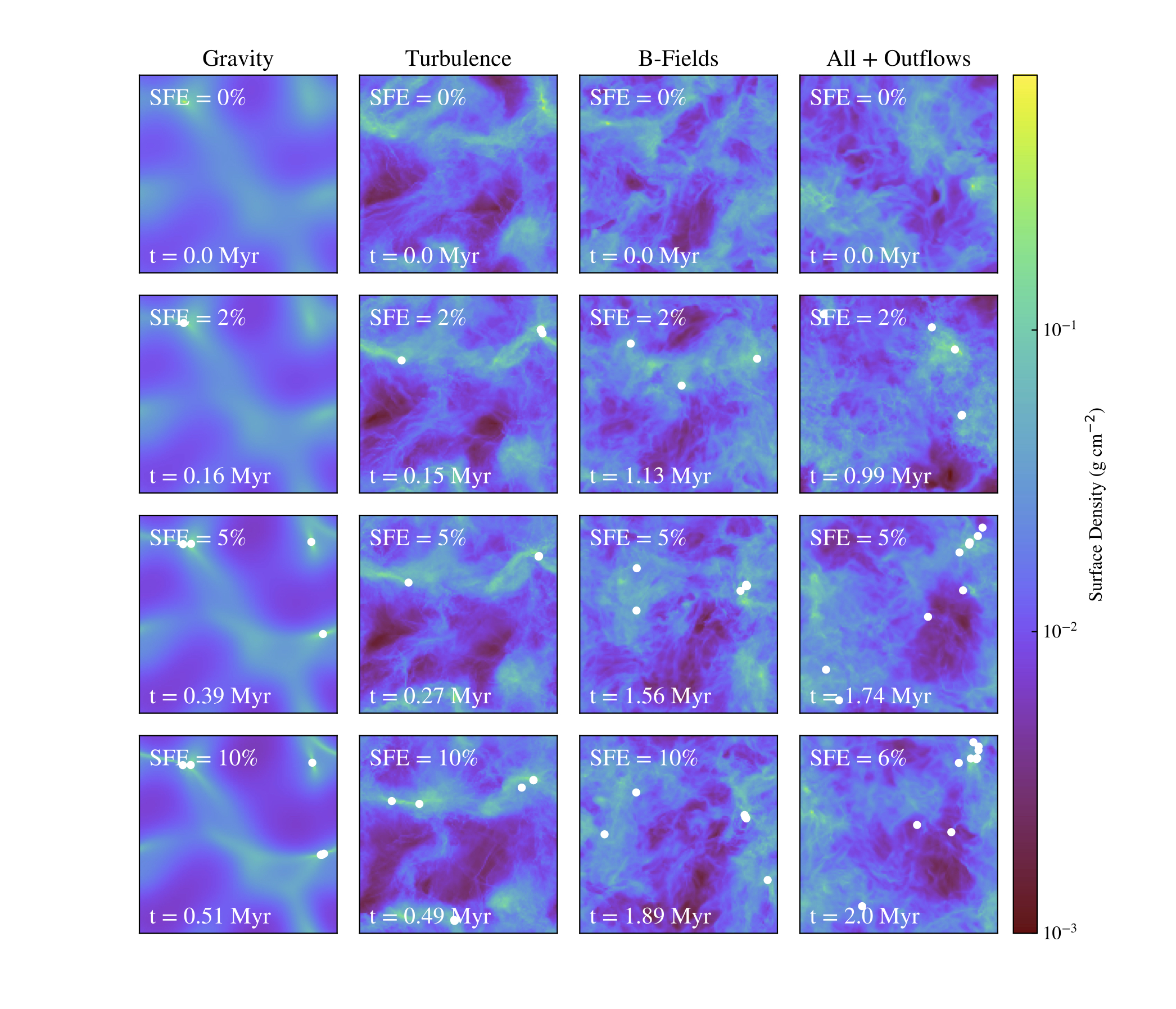
The following plots show a series of projection plots from the simulations used in our 2022 paper
(Appel et al. 2022), which explores the density PDF
of simulations that progressively include more physical processes.
Projection plots of the simulations from
Appel et al. 2022.
Movies of some of these simulations, as well as new versions of the simulations, can be found
here.
We explored the gas dynamics of simulations of star-forming regions in
our 2023 paper (Appel et al. 2023).
We measured the expansion and compression rates of the gas to explore the role of different physical processes,
including protostellar jets, in setting the gas dynamics in star-forming regions.
Publications
A complete list of the papers that I am on can be found in this
SciX Library.
Teaching is a foundational part of developing future generations of scientists,
making it one of our most important roles as professional scientists. Indeed,
teaching and mentoring are fundamentally intertwined and so there is a lot of overlap
between my teaching and mentoring philosophies. My teaching philosophy shares
a foundation with my mentoring philosophy and is guided by the dual principles of respect
and joy: respect for the student, the material, and the community; and sharing with
students my joy in the study of science, in learning new things, and in the collaborative
process of research. My approach to teaching centers around ensuring that every student is
given an equal opportunity to succeed in their academic goals, whether that is in an
individual course, in pursuit of their degree, or in developing long-term career goals.
My goal in every teaching moment is to respect the individual goals of my students and
to share my knowledge and enjoyment of physics and astronomy with them, whether this is
their only STEM course or one of many.
In practice, this means:
Recognizing individuality: My teaching goals mean respecting each student as
an independent learner with their own background, goals, and needs. This also means
celebrating each student successes, but also supporting them through adversity.
Respecting the different goals of students also translates into course design: for example,
the goals of an upper-level major course should focus on developing the skills needed for
professional scientists, while the goals of an intro course for non-majors should focus on
giving students a positive experience with STEM that will encourage them to be life-long
learners of science.
High expectations paired with robust support: Respect for students as independent
learners means pairing high expectations for each student with sufficient support and
compassion to help them meet those expectations.
Committing to accessibility: Respect for students as individuals also means
committing to prioritizing accessibility and striving to make the course, the classroom,
or the research environment accessible to every student. This includes adapting to formal
accommodations, adjusting expectations when needed, or prioritizing accessible course
design, such as including material in multiple formats and multiple modes of assessments.
I prioritize clear communication of expectations and of evaluation strategies.
Learning from education research: I strive to learn from education researchers
to find ways to improve my teaching, including by finding ways to help students develop
a scientific identity and incorporating active learning strategies. Active learning
strategies are important for ensuring that each student has a chance to engage with
material in a way that encourages enthusiasm and genuine engagement.
Prioritizing interactions with students: These principles of respect and joy
also translate into prioritizing interactions with students, including questions and discussion.
I encourage questions from students and strive to answer every question thoughtfully. I make
a point of admitting when I do not know the answer to a question to show that it is okay to
not know things sometimes, while explaining how I would go about finding the answer.
Sharing my enthusiasm: I find that teaching is most successful when I can spark
true enthusiasm in my students. I find great joy in the study of astronomy and physics,
and sharing my enjoyment of the material and the process of science with students is a
foundational goal for me every time I walk into a classroom or student meeting.
As I note in my mentoring philosophy, no matter our career stage, we are all learning and
continuously growing our professional skills. For me, this includes always seeking ways to be
a better teacher and mentor. And so, while this statement reflects my teaching philosophy as of
September 2026, I fully expect that my philosophy will develop with time. Thus, this statement
may be updated at any time.
Many thanks to everyone whose conversation and ideas contributed to me refining my ideas!
If you are inspired by this statement and wish to incorporate elements of it in your own work, that’s
wonderful! If you do use a direct quote, please include appropriate credit, such as a citation to
this statement.
Teaching Experience
As an NSF Astronomy & Astrophysics Postdoctoral Fellow I am working on a project to develop
high school curriculum materials that introduce students to the basic ideas of computational
astrophysics. These materials will introduce students to the fact that coding is a tool for
science and that science can be studied with computers. I am collaborating with experienced
educators at the Gottesman Center for Teaching and Learning on this project.
As a graduate student, I served as a TA for several undergraduate courses of various levels.
For instance, in the fall of 2022, I was a TA for an undergraduate Computational Astrophysics course where
I helped juniors and seniors progress from the basics of coding in python to running astrophysical simulations.
As an undergraduate student, I was a TA for an introductory Physics lab for three years.
For more about my previous teaching experiences, please take a look at my CV.
Mentoring
Mentoring Philosophy
I consider mentoring to be one of the most important professional commitments of any
professional scientist. Mentoring is crucial for developing future scientists and for maintaining
a welcoming, supportive, and vibrant scientific community. Thus, my mentoring philosophy is
guided by the dual principles of respect and joy. I believe that every mentoring interaction
should be guided by respect for the unique needs, perspectives, and backgrounds of my mentees
and myself, and by the goal of fostering true enjoyment of the study of science and of the
field of astrophysics. Developing and maintaining a supportive community that enables the
development of independent, successful scientists requires proactive and ongoing work.
In practice, this translates to a few key principles:
Honesty and respect: Responsible and honest conduct of research is always a must.
But more than that, research is a human endeavor. I strive to be honest about my own strengths,
weaknesses, and boundaries, and will respect those of my mentees. I will encourage my mentees to
do the same. I always respect my mentees as capable and independent scientists.
Advocacy: As a mentor, one of my key roles is to advocate for my mentees. This means
advertising their work alongside my own, helping them make relevant professional connections
(including with other potential mentors), and championing their needs. This also means working
with them to understand their unique career goals, supporting their progress towards achieving
those goals, and helping them to develop their identity as a scientist. Moreover, science is
collaborative. This means that the successes of my mentees contribute to my own success and
vice versa. Therefore, I share responsibility for helping my mentees succeed in their goals.
None of us are in this alone!
Clear and effective communication: Effective mentoring must be founded on clear,
effective, and timely communication. This includes clearly communicating boundaries with
respect to work hours and communication methods. This also includes establishing a mentoring
agreement at the start of any long-term mentoring relationship.
Transparency: Respect for the needs and goals of my mentees makes transparency crucial.
This means clearly establishing expectations early on, as well as clearly and promptly
communicating any changes to expectations, goals, or boundaries. This includes establishing
a mentoring agreement at the start of any long-term mentoring relationship; communicating
clearly about meeting frequency, expected hours, and communication methods; and honest
evaluation of mentor and mentee progress.
Adaptability, flexibility, and compassion: Every mentee has unique needs, strengths,
and goals. And sometimes things change unexpectedly. Part of showing respect for my mentees
and for myself is committing to adapting to the needs and long-term goals of each mentee.
This can mean adjusting project goals and expectations to fit each student’s goals and skills,
adjusting communications methods as needed, and approaching unexpected developments with compassion
and patience. This overlaps with the next principle:
We are both human: I commit to always having compassion for, and patience in the face of,
unexpected professional and personal challenges. And I will always strive to share my joy in the
study of astrophysics with mentees and to celebrate their successes. In addition, valuing our
shared humanity means that any time I communicate with students, evaluate student work, or
write reference letters, I will use my own words and will not use generative AI.
Peer mentoring and informal mentoring are important: In addition to formal mentoring
relationships established with research mentees or in a classroom setting, I value the opportunities
I have to be an effective and supportive mentor in any setting or for any duration. I always
strive to make time to support my peers and colleagues of any career stage with the same care
I show any mentee.
I end this statement with the observation that, no matter our career stage, we are all
learning and continuously growing our professional skills. For me, this includes always seeking
ways to be a better mentor. And so, while this statement reflects my mentoring philosophy
as of September 2026, I fully expect that my philosophy will develop with time. Thus, this
statement may be updated at any time.
This statement was inspired in part by Project BUILD and discussions with colleagues.
Many thanks to everyone whose conversation and ideas contributed to me refining my ideas!
If you are inspired by this statement and wish to incorporate elements of it in your own work,
that’s wonderful! If you do use a direct quote, please include appropriate credit, such
as a citation to this statement.
Research Mentees
Over the years, I have mentored four undergraduate research students.
Edwin Lliguicota was an AstroComNYC student at AMNH during the Summer of 2026. He
worked with me to explore the formation of runaway stars in star clusters simulated with
Torch. He is now an undergraduate student at Cornell University.
Donglin Wu is a Yale undergraduate student and was a summer research student at
AMNH during the Summer of 2026. He is working with Prof. Mordecai-Mark Mac Low, Dr. Brooke
Polak, and me on the escape of UV radiation from star clusters simulated with Torch.
Fred Javier was an AMNH Physical Sciences REU Student during the Summer of 2025
and returned as a summer research student again in the Summer of 2026. He is working with
Prof. Mordecai-Mark Mac Low and me on a project investigating the temperature and density
PDFs, and temperature-density phase space, of star-forming clouds with and without protostellar
jets that were simulated with Torch.
Avery Kiihne was a Rutgers undergraduate student
(now graduated!) and worked with Prof. Blakesley Burkhart and
me on a research project investigating fitting methods for simulated column density PDFs. You can find
their first paper here!
For more about my previous mentoring experiences, please take a look at my CV.
Service & Outreach
Contributing to the development of a welcoming and supportive community in the field of Physics and Astronomy is
a lasting priority for me. This goal informs my teaching, mentoring, and outreach activities.
While I was a graduate student at Rutgers University, I was significantly involved in
the Rutgers Minorities in Physics and Astronomy (MiPA) group,
including serving as the Graduate Chair, President, and Past President at various points.
MiPA is dedicated to furthering the interests of and developing a sense of community among members
of the Rutgers Physics and Astronomy department who are underrepresented or historically marginalized in Physics and Astronomy.
As a leader of MiPA, I helped to draft and implement a Charter and Code of Conduct for MiPA.
I also founded the Equity and Inclusion Journal Club.
Over my time with MiPA, I led or helped organize various events and initiatives.
For more about my service and outreach roles, please take a look at my CV.
Disclaimer
Sabrina M. Appel is supported by the National Science Foundation under Award No. 2401740. This website includes material based on
work supported by the National Science Foundation under this Award. Any opinions, findings, and
conclusions or recommendations expressed in this material are those of the author (Sabrina M. Appel) and do not
necessarily reflect the views of the National Science Foundation.
This is bold and this is strong. This is italic and this is emphasized.
This is superscript text and this is subscript text.
This is underlined and this is code: for (;;) { ... }. Finally, this is a link.
Heading Level 2
Heading Level 3
Heading Level 4
Heading Level 5
Heading Level 6
Blockquote
Fringilla nisl. Donec accumsan interdum nisi, quis tincidunt felis sagittis eget tempus euismod. Vestibulum ante ipsum primis in faucibus vestibulum. Blandit adipiscing eu felis iaculis volutpat ac adipiscing accumsan faucibus. Vestibulum ante ipsum primis in faucibus lorem ipsum dolor sit amet nullam adipiscing eu felis.
Preformatted
i = 0;

while (!deck.isInOrder()) {
    print 'Iteration ' + i;
    deck.shuffle();
    i++;
}

print 'It took ' + i + ' iterations to sort the deck.';

 https://orcid.org/0000-0002-6593-3800